
Through virtual simulations and practical training, a Nigeria-based initiative is equipping African researchers with the skills to design, test, and manufacture the continent’s own vaccines.
By
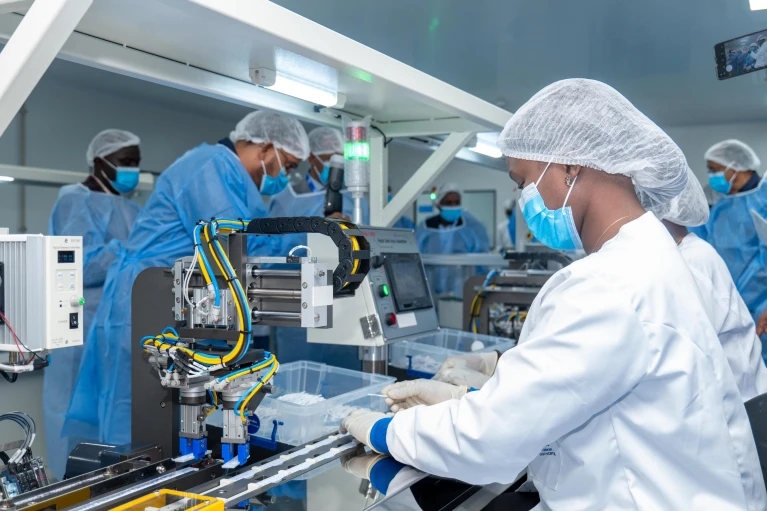
For decades, Africa has depended on imported vaccines to fight its deadliest diseases, producing just 0.2% of the world’s vaccines despite being home to over 15% of the world’s population. But a new initiative — the African Vaccine Academy (AVA) — is working to change that by training scientists and researchers to close that gap as part of the continent’s drive to produce 60% of its own vaccines by 2040.
Launched in December 2023 by the Nigeria-based think tank Bloom Public Health, in partnership with European institutions, the AVA blends virtual learning with practical simulations to equip African professionals with the skills needed to develop and manufacture vaccines.
“It is a foundational pillar for Africa’s future in global health,” says Olutoun Sanusi-Oladunni, a pharmacist specialising in global vaccine access and health security, who leads the initiative. It is more than an educational programme.”
By focusing on mRNA technology which is both quick and versatile, the programme aims to shorten the path from scientific discovery to vaccine rollout. Training combines online learning, practical case studies, and virtual simulations, and is supported by the Biotech Training Facility (BTF) in the Netherlands and collaborators across academia, industry, and public health.
“The most valuable thing is how scholars engage with real-world vaccine processes virtually,” says Cynthia de Leeuw, senior commercial director at BTF. “Africa has amazing talent, but practical experience in vaccine production is limited. Our role is to transfer knowledge and hands-on training so that African scientists can strengthen their own vaccine ecosystem and prepare for future pandemics.”
In 2024, over 40 scholars joined two cohorts, ranging from pharmacists and researchers to veterinarians and STEM students, collaborating on research, papers, and conferences addressing local vaccine manufacturing challenges.
Ashraf Ahmed, compliance section head at BioGeneric Pharma in Egypt, who participated in the programme, says, “Most of the courses were about quality assurance, chain controls, deviations, documentation—exactly what I do in my role. And I could immediately transfer what I learned to my team.”
For Nigerian participant Franklyn Oluwadare, the programme offered regulatory insights and cross-African collaboration. “Modules on good manufacturing practices and contamination control were eye-opening, and working with peers from across Africa showed how collective expertise can solve real-world challenges,” says Oluwadare.
The AVA also runs regular webinars attracting hundreds of participants, covering topics from manufacturing challenges and data integrity to strategies for strengthening Africa’s production capacity.
But challenges remain, including funding, infrastructure gaps, limited access to advanced technology, and policy constraints. “No matter how great an idea is, you need people to buy into it. You cannot do it alone,” says Sanusi-Oladunni. Ahmed adds: “Building a vaccine manufacturing facility requires huge funding and hands-on experience aligned with international guidelines. Local capacity is essential to avoid delays like those during COVID-19.”
Looking ahead, AVA plans a state-of-the-art training facility in Africa to reduce reliance on overseas laboratories. “We are scouting for the best-suited country for the facility, but we cannot wait,” says Sanusi-Oladunni.
doi: https://doi.org/10.1038/d44148-025-00329-5
References
- Meissner, F., Geddes-McAlister, J., Mann, M. et al. Nat. Rev. Drug. Discov. 21, 637–654 (2022).Article PubMed Google Scholar
- Sternicki, L., Poulsen, S. RSC. Med. Chem. (2025) preprint at https://doi.org/10.1039/d5md00617a
- Lee, S., Chintalapudi, K., Badu-Tawiah, A. Annu. Rev. Anal. Chem. 14 437-465 (2021).Article PubMed Google Scholar